A Case of Operational Improvement: From a Server Failure to Rebuilding Our Website
October 7, 2026 (Updated: October 11, 2026) | Fuminobu Imamura, Gyoseishoshi

AI can change how work gets done in a big way. But the more convenient it makes things, the bigger the impact when it gets something wrong. That is why the key is for people to decide in advance what AI may do, and then let AI work within that scope. Once the scope is set, work that used to take hours can be done by AI in a short time, and done reliably.
This is the second article in the series announced in What Are AEGIS Digital Services?. In the first article, we described how we went from a small Raspberry Pi 5 to building our own GPU server. This time, we start with the failure we mentioned there, the one that taught us just how big that impact can be.
Following AI’s Suggestion, Our Server Stopped Working
One night, not long after our GPU server started running, AI looked at our server’s settings screen and suggested that the GPU was being held back, and that changing how the GPU is connected in the settings would give it its full performance. The server was running without any trouble. Even so, convinced by an explanation that sounded reasonable, we changed the setting on the spot.

A note at the bottom of the screen warned that the system might fail to start; we should have reconsidered AI’s suggestion. Having taken it without putting our own judgment in between, we saw a warning light come on, and the server would no longer start.

Nothing we tried fixed it. We could not even open the settings, and AI’s answer was that there was nothing more it could do. Still, we changed our approach completely and kept trying, and at last the settings screen opened. We undid the change, and it was well into the next day by the time the server was running again.
The setting had never needed changing. AI’s power is real, but when it misses, the impact is just as big. Telling which suggestions to take requires knowing how things work, and the experience of having tried and failed.
From this experience, we set rules for working with AI.
- The more a change is meant to improve things, the more you should think first about what happens if it backfires
- Before changing anything, check what will change, what happens if it fails, and how to undo it
- Make full use of AI’s suggestions. Whether to take them, and the responsibility that comes with it, stays with people
Rebuilding Our Website in Four Days
With the scope of what we leave to AI decided, the first thing we changed in a big way was this website.
We had built our previous website ourselves, from scratch, as well. We decided the design, wrote the text, and put the pages together one by one. Even fixing a single sentence meant opening the editor and making the change by hand, which took a lot of effort.
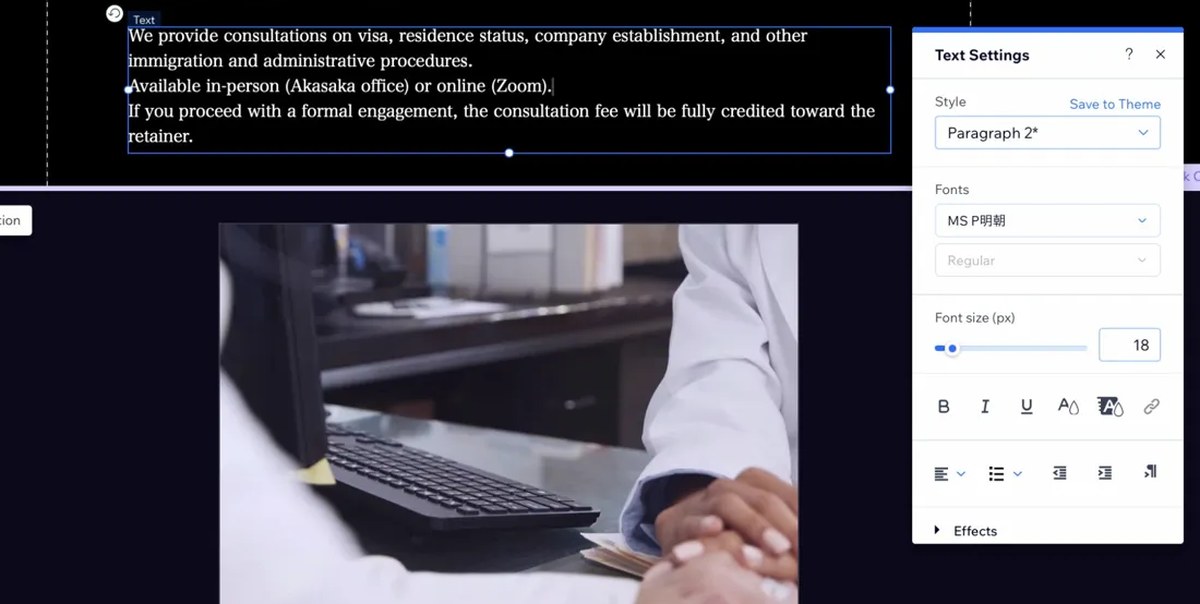
So we rebuilt the website. We remade every page and article as plain text files that AI can read and write directly, and published it four days after we started. Every change is recorded, so we can always go back to an earlier state.
During those four days, people decided the following:
- Who the website is for, and what it should say
- Information that must not be wrong, such as the office name, address, and contact details
- Whether it was ready to publish
Building the pages, adjusting the design, drafting the text, and the steps for moving the site were done together with AI.
What Used to Be Hard Now Takes Moments
Today, work that used to take hours is done quickly when we ask AI.
- Consistent details: Change shared items once, and every page is updated
- Keeping content current: When information related to an article changes, we are notified and keep it up to date
- Posts for each channel: Social media and other posts are created together with the article, under the same decision
It is not just about speed. What AI produces goes out only after it has been checked using steps that people decided. Because the scope of what we leave to AI and the steps for checking are set in advance, we can have both speed and reliability.
Key Points for Implementation
From our experience, here are three things we would pass on to anyone improving their operations with AI.
- Decide the scope first: Before the work starts, people decide what AI may do and what it may touch
- People are responsible for the result: Before taking an AI suggestion, check whether it is really needed and what happens if it backfires
- Build in the checking steps too: Do not stop at building something; decide how it will be checked before it goes out
In the next article, we look at how to protect the information entrusted to us when AI works directly on our behalf.
How We Can Help
Drawing on our experience building and running these systems ourselves, we support offices and businesses in improving their operations.
- Deciding what to leave to AI: We help you sort out which tasks to leave to AI and where people should decide
- Rebuilding and running your website: We support rebuilding your website into one you can keep improving together with AI, and setting up how it will be run after launch
- Designing checking steps: We propose steps for people to check what AI produces
For inquiries about Digital Services, please feel free to reach out via our contact form.
This article is published as part of activities pursuant to Article 1-2, paragraph 2 of the amended Gyoseishoshi Act.
This article is based on laws and official information as of October 11, 2026. Rules and practice may change, so please check the latest information before applying.
Free estimates available.
Please feel free to contact us.
For detailed pricing, please see our Fees page.
Contact Us